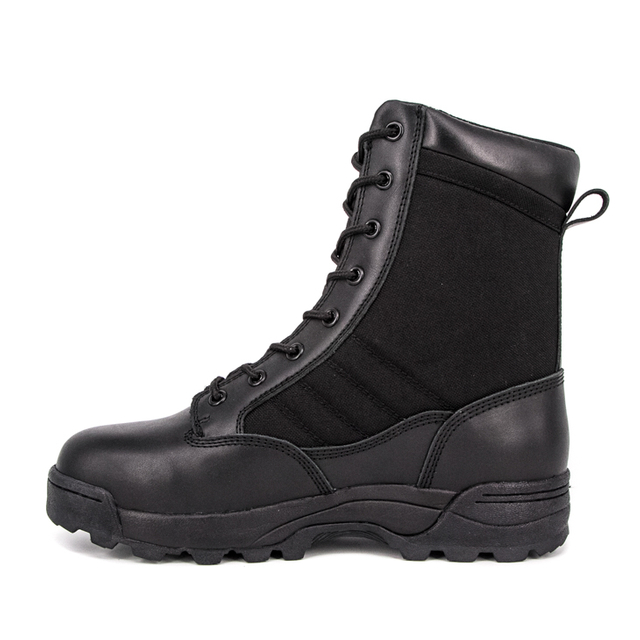
Army men's tactical boots is the best choice for soldiers. Military tactical boots are made well and durable,it can completely protect soldier’s feet. It can give people a sense of upright and high-rise, also it looks very powerful. That’s why many people love army men's tactical boots.
Skin is the state of collagen fibers in the skin when they are still in the animal body.
Leather refers to the physical and chemical treatment of animal skin, which removes the useless ingredients from the skin, and changes the chemical structure of collagen fibers in the skin, which is different from that in the animal body.Leather is soft and flexible in dry state and easy to rot in wet state.Leather is the raw material of leather. Leather is made of leather,it is a fixed term now. It refers to chemically treated leather. Now some people call natural leather as non-natural leather for short. It is to distinguish natural leather from synthetic leather.
Leather is the most commonly used natural raw material.The cowhide can be divided into several layers. The outermost layer is the scalp, with the best quality, followed by the second layer. Its strength, elasticity and air permeability are not as good as the scalp.
The scalp cortex is composed of a dense and thin fibrous layer and a slightly loose transition layer closely connected with it. It has good strength, elasticity and process plasticity.
The split leather is made by dividing the skin into two layers.It maintains certain natural elasticity and process plasticity, but its strength is poor.
Milforce Equipment Co.,Ltd. is a premium quality supplier of military boots, serving
customers over more than 38 countries worldwide, including Europe, Americas, Africa,
the Middle East ,etc. Established in 1984
fuction:MD outsole, comfortable and light, non-slip and wear-resistant, front and rear line, increase the fastness of the upper and the sole. The side zipper is quickly worn off. Breathable eyelets keep the air circulation inside the shoe.
Procuring footwear for government agencies requires balancing strict budgets against the demand for high-performance gear. Institutional buyers and quartermasters navigate a fragmented market filled with complex compliance standards and fluctuating supply chains.
Foot health dictates officer safety, endurance, and focus during grueling 10- to 12-hour shifts. The persistent dilemma involves selecting footwear that blocks external moisture versus footwear that vents internal heat.
Law enforcement and first responder footwear has shifted heavily toward rapid-deployment designs over the last decade. Patrol officers, paramedics, and security personnel increasingly rely on side-zip models to meet demanding shift requirements.
Law enforcement patrol work physically breaks down the human body over time. You spend 12-hour shifts standing on asphalt, running through unpredictable terrain, and carrying 20 to 30 pounds of gear on your duty belt and vest.
Choosing the right military desert boots is essential for users who operate in hot, dry, and challenging environments. Unlike ordinary outdoor footwear, military desert boots need to provide a balance of breathability, durability, traction, protection, and long-term wearing comfort.
Waterproof military desert boots may sound unusual at first. Desert environments are often associated with heat, sand, dust, and dry weather, so many buyers assume that waterproof protection is unnecessary. In reality, military and tactical users may face more complex conditions than pure dry sand.
Military desert boots used in the Middle East and Saudi Arabia need to handle more than high temperatures. These regions can include open desert, rocky ground, fine sand, dry roads, temporary camps, vehicle areas, and occasional wet or muddy surfaces.